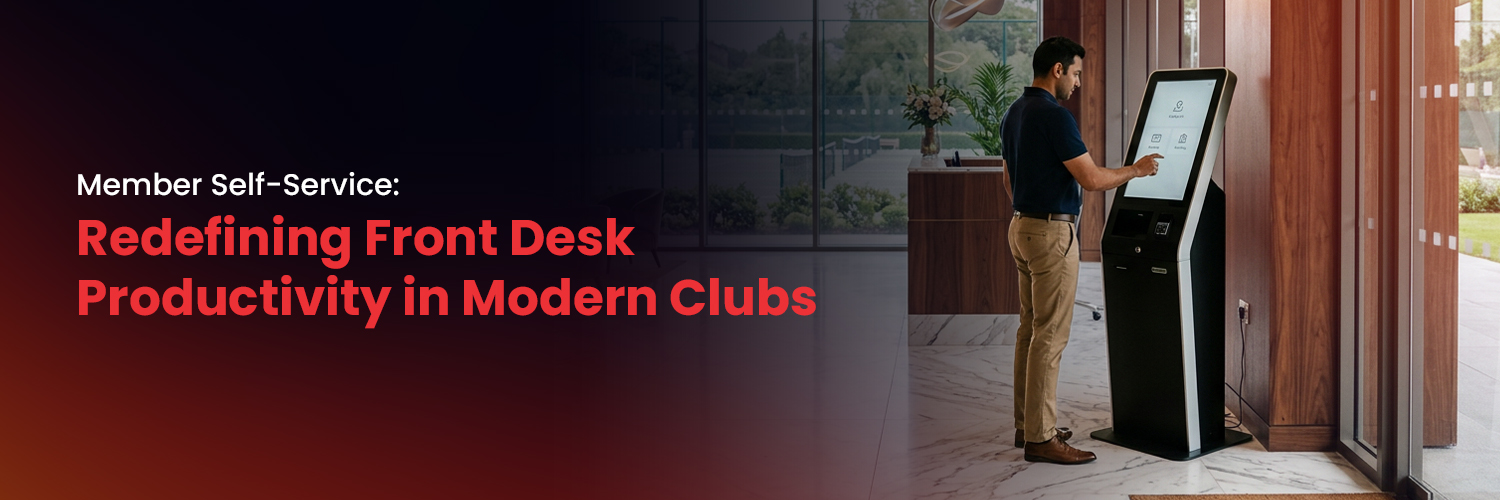
Modern clubs are evolving quickly as member expectations shift toward instant, digital-first experiences. Whether it's booking a court, checking dues, or updating personal information, members no longer want to depend on physical front desk interactions for routine tasks.
This shift is pushing clubs to rethink traditional operations. Member self-service is emerging as a key enabler of efficiency, and platforms like eCube are helping clubs deliver this transformation. Beyond convenience, self-service directly impacts front desk productivity, staff efficiency, and overall member satisfaction.
The Traditional Front Desk Challenge
In many clubs, the front desk acts as the operational hub for almost every member interaction. While essential, this creates several challenges:
- High volume of repetitive queries such as bookings, payments, and account updates
- Peak-hour congestion leading to long queues and delays
- Heavy dependence on staff for even simple requests
- Manual record handling increasing the risk of errors
- Limited time for staff to focus on member engagement
Over time, these issues create operational bottlenecks and reduce both staff efficiency and member satisfaction.
Why Member Self-Service is Essential for Productivity
Member self-service is not just a convenience feature — it has become a necessity for improving operational productivity in modern clubs.
Firstly, member expectations have changed. People are used to managing banking, shopping, and travel digitally. They expect the same ease in club interactions.
Secondly, clubs are handling growing member bases without proportional increases in staffing. This puts pressure on existing teams and makes manual processes unsustainable.
Thirdly, a large portion of front desk activity is repetitive and transactional. Tasks like booking confirmations or balance inquiries do not require human intervention but still consume staff time.
Finally, peak-time demand creates unavoidable bottlenecks. Even well-staffed front desks struggle when many members arrive simultaneously.
Self-service systems solve these challenges by shifting routine tasks away from staff and into digital platforms, enabling 24/7 access without increasing operational load.
The eCube Advantage
The real impact of member self-service on front desk productivity is only fully realized when it is powered by a well-integrated club management system like eCube. Self-service on its own is just a feature; within a club management platform, it becomes a structured, scalable operational model.
1. Eliminates Dependency on Front Desk for Routine Tasks
A major productivity drain at the front desk is handling repetitive member requests. With a club management system, members can directly:
- Book facilities and sessions
- Check availability in real time
- View and download invoices
- Make payments instantly
This removes a large portion of daily walk-ins and calls, allowing front desk staff to focus on exceptions rather than routine transactions.
2. Reduces Operational Interruptions for Staff
Without self-service, staff constantly switch between tasks — answering queries, updating records, and managing bookings. This interrupts workflow and reduces efficiency.
With eCube-enabled self-service, members handle these actions independently, significantly reducing interruptions at the front desk and allowing staff to work in a more structured and focused manner.
3. Converts Front Desk into a Support and Experience Hub
When transactional work is minimized, the role of the front desk naturally evolves. Instead of being a processing center, it becomes a member support and engagement point.
Staff can spend more time:
- Assisting with complex requests
- Enhancing member experience
- Providing personalized service
- Managing exceptions rather than routine flows
This shift directly improves productivity without increasing workload.
4. Ensures Faster Resolution Through Real-Time Data Access
Self-service powered by a club management system ensures members are always working with real-time information. Whether it is booking availability or payment status, updates are instant and accurate.
This reduces back-and-forth communication with the front desk and eliminates delays caused by manual verification.
5. Reduces Peak-Time Pressure on Front Desk
Peak hours often overload reception counters, leading to long queues and slower service. Self-service spreads demand evenly by allowing members to complete tasks before arriving or without visiting the desk at all.
This smoothens traffic flow and prevents operational bottlenecks during busy periods.
6. Improves Accuracy and Reduces Rework
Manual handling at the front desk often leads to errors in bookings, updates, or records, which then require correction.
With a system like eCube, member-driven self-service ensures data is entered directly by users and processed automatically, reducing errors and eliminating time spent on rework.
7. Enables Scalable Productivity Without Increasing Staff Load
As membership grows, front desk workload typically increases linearly in traditional setups. However, with self-service enabled through a club management platform, the same team can efficiently manage a much larger member base without proportional increases in effort.
This scalability is one of the most significant productivity advantages.
Conclusion
Member self-service is no longer optional — it is essential for modern club operations. It addresses key challenges such as workload overload, service delays, and scalability limitations while improving both staff productivity and member experience.
Platforms like eCube enable this transformation by digitizing routine processes and empowering members with 24/7 access to services. The result is a more efficient front desk, happier members, and a more scalable club operation.
FAQs
1. What is member self-service in a club management system?
Member self-service allows club members to independently perform routine tasks such as booking facilities, checking invoices, making payments, and updating their profiles through a digital platform without relying on the front desk.
2. How does self-service improve front desk productivity?
Self-service reduces the volume of repetitive walk-ins and calls, minimizes manual data entry, and eliminates peak-hour bottlenecks. This allows front desk staff to focus on member engagement and higher-value activities.
3. Does self-service replace front desk staff?
No. Self-service does not replace staff—it enhances their role. It reduces transactional workload so staff can focus on personalized service, problem-solving, and improving member experience.
4. What kind of tasks can members handle through eCube?
With eCube, members can book facilities, view availability, access invoices, make payments, and manage basic account information—all without visiting the front desk.
5. How does self-service reduce errors in club operations?
Since members directly enter and manage their requests through a digital system, manual data handling is minimized. This reduces errors in bookings, updates, and record management.
6. Can self-service handle peak-time pressure at the front desk?
Yes. By enabling members to complete tasks digitally, self-service reduces physical crowding and distributes demand evenly, significantly easing peak-hour pressure.
7. Why is a club management system important for self-service?
A club management system like eCube ensures self-service is not fragmented. It centralizes data, automates workflows, and provides real-time updates, making self-service efficient and reliable.